.jpeg?w=1080&h=810)
.jpeg?w=1080&h=720)

Latest research results | Drinking Pu'er ripe tea with meals can promote insulin secretion
Mar 24,2024 | taetea

Multiple studies have shown that people who drink tea every day have a lower risk of developing type 2 diabetes than those who don't drink tea.
What is the mechanism by which drinking tea reduces the risk of diabetes? Recently, the "Chinese Journal of Clinical Pharmacology" published a "clinical observation" study on the effects of tea ingredients on human insulin secretion completed by Dr. Liu Yanjun and his team from Lanzhou Ruijing Diabetes Hospital, which revealed the mystery. Let's take a closer look. Let’s talk about the relationship between Pu’er tea and insulin.
01 Insulin and diabetes
insulin therapy
Before the 20th century, diabetes was a terminal disease. People who had diabetes were sentenced to death, and there was nothing they could do. Until the discovery of insulin, the first clinical trial of insulin therapy for diabetics in medical history was officially declared successful. Since then, insulin has transformed diabetes from a terminal illness into a controllable chronic disease. By the 21st century, diabetes has become a very common chronic disease.
-1.jpeg?w=1080&h=608)
Insulin is the only hormone in the human body that can lower blood sugar levels. There are many hormones in the human body that affect blood sugar levels, such as epinephrine, growth hormone, glucagon, etc., which can raise blood sugar, but only insulin can lower blood sugar.
What role does insulin play in the body?
When blood containing a large amount of glucose flows through the pancreas, the beta cells in the pancreas detect an increase in blood sugar concentration and release insulin into the blood to lower blood sugar and maintain blood sugar concentration within a normal range.
Insulin lowers blood sugar in two ways:
The first is to organize cells throughout the body to consume glucose. Insulin is like a "key" that can "open the door" on the cell wall, allowing glucose to leave the blood and enter the cells, and then convert glucose into glycogen, energy, fat, etc. in the cells through other channels. , thereby lowering blood sugar;
The second is to inhibit the decomposition of glycogen into glucose and the conversion of non-sugar substances such as fat and protein into glucose.
.jpeg?w=1080&h=591)
As the only hormone in the human body that can lower blood sugar, when the production of insulin is destroyed, that is, "the key is not enough to open so many doors", resulting in the inability to lower blood sugar, and the human body will suffer from type 1 diabetes.
The pathogenesis of type 2 diabetes is not clear yet, but it is generally believed to be an endocrine disorder syndrome mainly characterized by insufficient insulin secretion and insulin resistance due to high-risk factors such as obesity and hypertension.
.jpeg?w=1080&h=720)
02 Pu'er tea and insulin secretion
Cell and animal experiments
Verified that plant active ingredients regulate insulin secretion
Insulin is so important, so what are the ways that affect the body's insulin secretion?
One is to directly improve the efficiency of insulin secretion in beta cells (increasing unit productivity); the other is to protect and repair beta cells by alleviating oxidative stress, anti-inflammation, etc. (to ensure a sufficient number of production units).
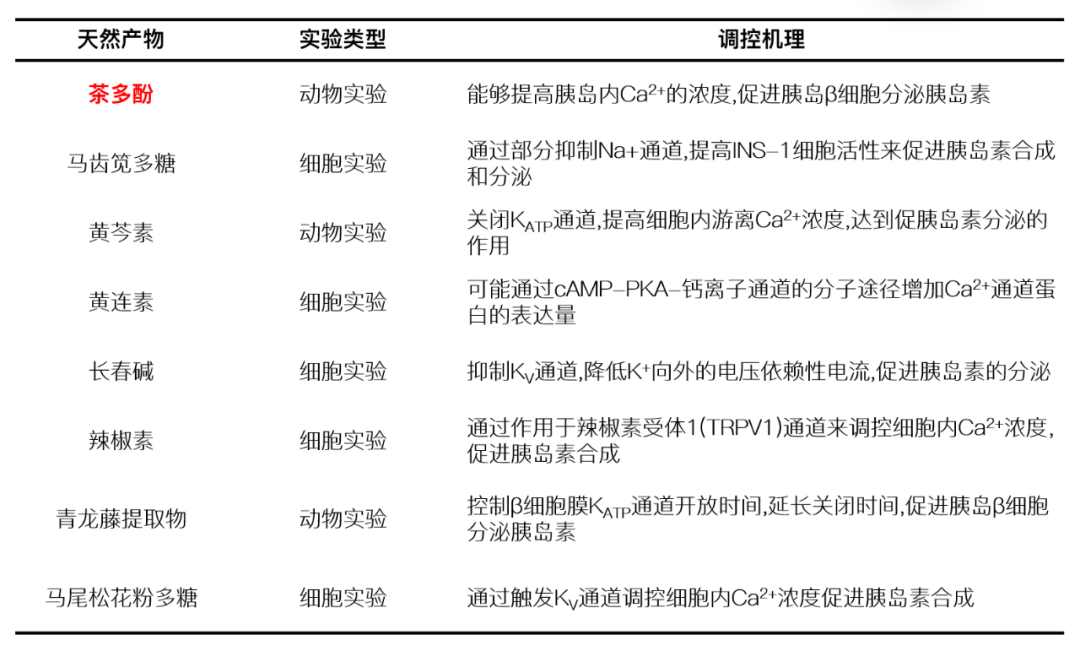
By sorting out the literature on the regulation of insulin secretion by plant active ingredients in recent years, it was found that many natural functional ingredients of different structural types, such as polysaccharides, flavonoids, terpenes, polyphenols and alkaloids, etc., can regulate insulin secretion through "Ion channel" mechanism of action to improve insulin secretion efficiency in beta cells (increase unit productivity).
Clinical Observation
Study on the effect of drinking Pu'er tea on insulin secretion
Although a large number of studies have shown that many plant active ingredients can promote insulin secretion, the human body is more complicated. Whether the regulatory effect of insulin secretion by pancreatic islet β cells in the human body is consistent with in vitro cell and animal experiments still requires further research. For example, in "improving unit productivity" Can the active ingredients of tea, which have effects on both aspects of "ensuring a sufficient number of production units", really increase insulin secretion in the human body? In March 2021, TAETEA No. 7 Hospital cooperated with Lanzhou Ruijing Diabetes Hospital to conduct a "clinical observation" study on the impact of tea ingredients on human insulin secretion.
Research subjects: Patients with newly diagnosed prediabetes and new-onset type 2 diabetes were randomly divided into a control group and an experimental group.
Research method: Taking the patients themselves as the control, the patients in the control group ate a steamed bun meal and drank water, and the experimental group ate a steamed bun meal and drank Pu'er tea. Then, the blood glucose levels were measured on an empty stomach and at 0.5 hours, 1 hour, 2 hours and 3 hours after eating the steamed bun meal. , insulin, C-peptide, glucagon and glucagon-like peptide index data, and then use statistical software to process and analyze the experimental data.
Research conclusion: After 2 years, the research results were published in "Chinese Clinical Pharmacology". Through human clinical observation, it was found that drinking ripe Pu'er tea with meals can promote insulin secretion in the body after meals. The mechanism of action may be that the active ingredients in Pu'er tea prompt intestinal cells to secrete more "glucagon-like peptide (GLP-1)", a hormone that promotes beta cells to secrete insulin.
.png?w=852&h=750)
03 Hit the key points
Through the above introduction, we can see that there is a close relationship between drinking Pu'er tea and insulin secretion. Cell experiments and animal experiments have proven that tea polyphenols, tea polysaccharides and other plant active ingredients can improve the efficiency of insulin secretion in beta cells through the mechanism of "regulating ion channels"; clinical observations further found that drinking Pu'er tea with a meal can promote insulin secretion after a meal. Insulin secretion in the body.
I hope more people can understand the benefits of drinking tea, improve bad habits in life, eat reasonably, prevent together, and live a healthy life!
参考文献:
[1]胡庆娟,崔申申,李玉萍.天然产物基于离子通道调控胰岛素分泌的研究进展[J].天然产物研究与开发,2017,29(5):888-892.
[2]刘月冉,冯潍,耿越.马尾松花粉酯化多糖对MIN6细胞胰岛素分泌和[Ca2+]的影响[J].药物生物技术,2013,20(2):137-140.
[3]Hu Q, Li Y, Liu C, et al. Effects of polysaccharide from Portulaca oleracea L. on voltage-gated Na+, channel of INS-1cells[J].Biomedicine & Pharmacotherapy,2018,101:572-578.
[4]郭阳艳.黄芩素对大鼠胰岛素分泌的作用及机制研究[D]太原:山西医科大学,2018.
[5]张敏.黄连素通过cAMP-PKA-钙离子通道促进胰岛素分泌的初步研究[D].天津:天津医科大学,2016:7-41.
[6]Yao X G, Chen F L, Li P, et al. Natural product vindoline stimulates insulin secretion and efficiently ameliorates glucose homeostasis in diabetic murine models[J].Journal of Ethnopharmacology,2013,150(1):285-297.
[7]张世奇,赵天天,赵丹,等.辣椒素在小鼠瘤βTC-6细胞中降糖机制的研究[J].营养学报,2018,40(1):64-70.
[8]杨蔚,黄民,车笛,等.青龙藤提取物对小白鼠胰岛β细胞ATP敏感钾 (KATP)通道的影响[J].中国应用生理学杂志,2001.17(2):165.
[9]王进,沈剑敏,黄华宇,等.茶多酚对胰岛素分泌和胰岛内钙离子浓度的影响[J].兰州大学学报 (医学版 ),2010,36(4):44-47.
[10]仇菊,朱宏,卢林纲.葡萄籽多酚对糖尿病大鼠的降血糖作用及其机制[J].食品科学,2018.39(1):226-231.
[11]宋林珍,朱丽云,高永生,等.茶多糖的结构特征与降血糖活性[J].食品科学,2018,39(19):162-168.
[12]Raish M, Ahmad A, Jan B L.et al. Momordicacharantia polysaccharides mitigate the progression of STZ induced diabetic nephropathy in rats[J].International Journal of Biological Macromolecules,2016,91:394-399.
[13]Gao J. Han Y L, Jin Z Y, et al. Protective effect of polysaccharides from Opuntia dilleniiHaw. fruits on streptozotocin induced diabetic rats[J].Carbohydrate Polymers,2015,124(5):25-34.
[14]李自河.海藻油和青钱柳多糖辅助降血糖功能研究与机制探讨[D].武汉:华中科技大学,2015.
[15]汪建红.陈晓琴.张蔚佼.黑果枸杞果实多糖降血糖生物功效及其机制研究[J].食品科学,2009,30(5):244-248.
Comment
.jpeg?w=1080&h=720)
.png?w=1080&h=1080)